
Building a Democratic and Transformative Food Movement
Our MULTI COALITION theory of change
The MKE Food Council’s theory of change is that by organizing MKE food organizations, businesses, their workers, and consumers into democratic member-run “coalitions”, providing facilitation and communication support, a democratic decision-making structure, and maintaining a shared Organizing Framework within and across our various coalitions, MFC can develop an informed, inclusive, long-lasting Milwaukee Food Movement - anchored in communication, coordination, and cooperation - that is an effective vehicle for change in the direction of our mission and vision.
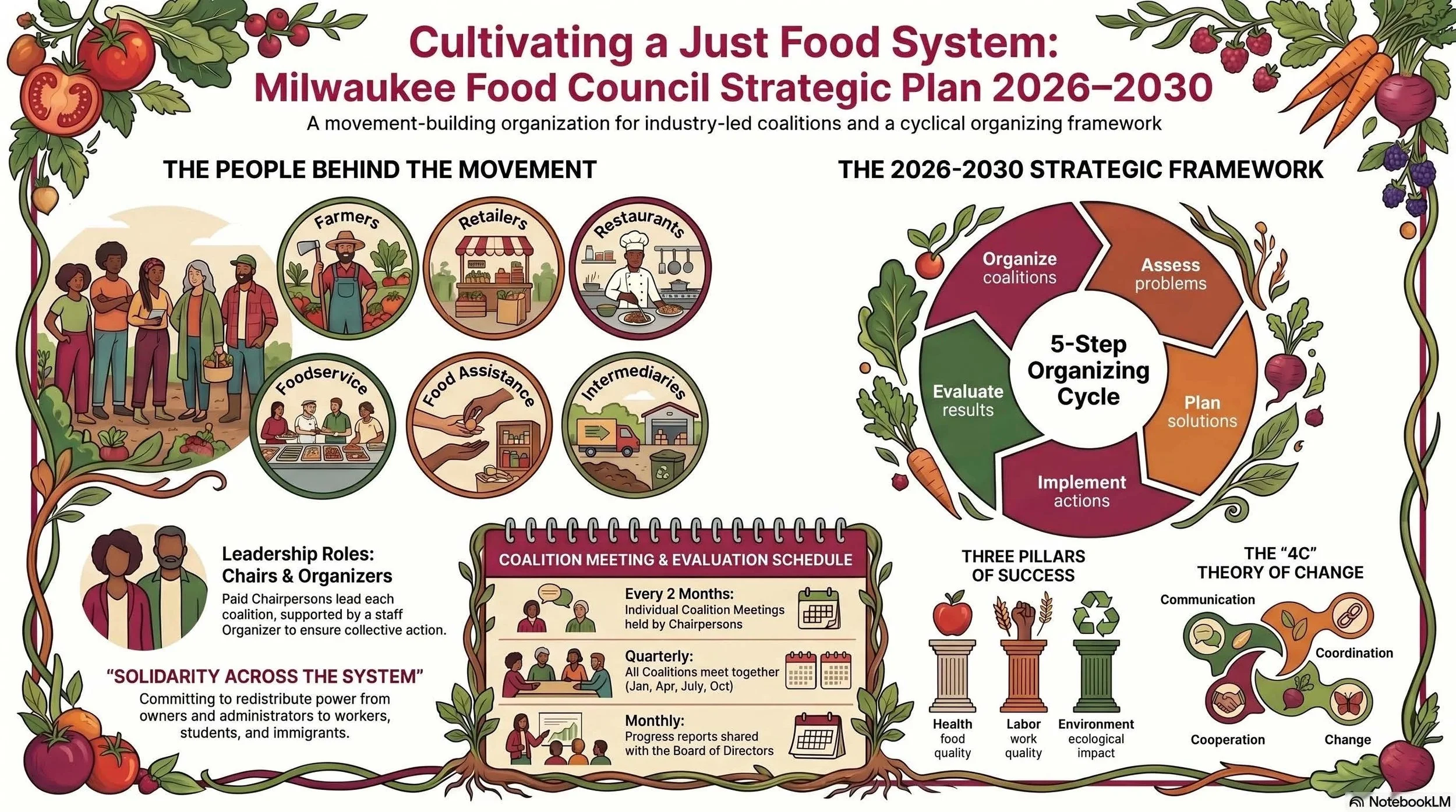
Convene, communicate, cooperate, and make CHANGE.
As a democratic, and member-driven organization - exactly what we do will be up to you, our members, to choose!
Solidarity
To inspire the realization of our interconnected struggles, that “injustice anywhere is a threat to justice everywhere”, and that wisdom is not synonymous with status - the MFC commits to redistribute and return power; not only to farm owners, but immigrant farmworkers; not only chefs, but dishwashers; not only school administrators, but so too, to students.
Readiness and Responding to the Moment
Whereas the central aim of MFC is to bolster an enduring Food Movement rooted in democratic principles and mass participation - a commitment that, though mountainous in size, is often glacial in momentum; the MFC respects the need to show up for and respond to the ever-evolving needs of our communities in real time. The MFC and its members, though steadfast and patient, are adaptable to the needs of the moment, and when elected by its membership, the MFC can be activated to the frontlines of any burgeoning crisis or event.
Measuring Change
Alongside members and allies the MFC selects indicators that most thoroughly demonstrate the overall state of our food system - from production to consumption, in between and back again - to be referenced within and across industry coalitions throughout the organizing processes. This informs our evaluation process, and begs the query, “what have we done? What has changed?” and directs the evaluation towards metrics as evidence of our work, our work’s efficacy, what requires continuation and, what else, redirection.